
June 2022 Update
Regular readers of my blog may know I was elected to Hawkesbury City Council in 2016, and was re-elected to a second term in December 2021.
I served on the Board of the Hawkesbury River County Council from 2016-2021 and also as its deputy Chair and Chairman between 2018 and 2021.
I have used my position as an elected representative to continue to advocate for my community – who endure the greatest unmitigated flood risk in Australia – and to ask the State and Federal governments to urgently commit to capital works for flood mitigation including raising Warragamba Dam.
My main writings on flooding are at my Councillor Website. You'll find much more current content there.
-Nathan.
--------------------------------
2nd March 2012 update: It's funny; I use a hit counter service to track who arrives at my blog and what they've typed into Google to get here. Every time it pours rain, I get a "flood" (pun intended) of traffic of people Googling "flooding", "Hawkesbury", "Nepean", and, amusingly "will my house flood in (insert almost every locality in the Hawkesbury Nepean basin)"
Nothing like a bit of rain to get people worried, is there? And it looks like the spillway will be opened at Warragamba for something like 14 years tonight. Everyone's going to wake up in the morning to the threat of bridges closed and all the inconvenience and danger that entails.
In addition to the below remarks I made a year ago, I feel more strongly than ever that people who live in on a flood plain need to better educate themselves about what has happened before. Certainly, the deluge (there I go again) of traffic shows people are interested.
Permit me to endorse the work of the Hawkesbury Nepean Flood Mitigation Action Committee, a group who have agitated for better long term planning, action and education in this area for many years. Harangue your state members. Speak to your local Councillors. Go to your Council and work out what level your house sits at, and acquaint yourselves with how frequently your area, or areas near you have gone under in the last 220 years.
Also, as a Hawkesbury/Nepean local, you might want to subscribe or favourite the other writings of my blog, as I range over subjects diverse and fascinating. Love to hear your feedback!
-Nathan
 |
| Extent of the 1867 flood in the Hawkesbury (from Hawkesbury Council) |
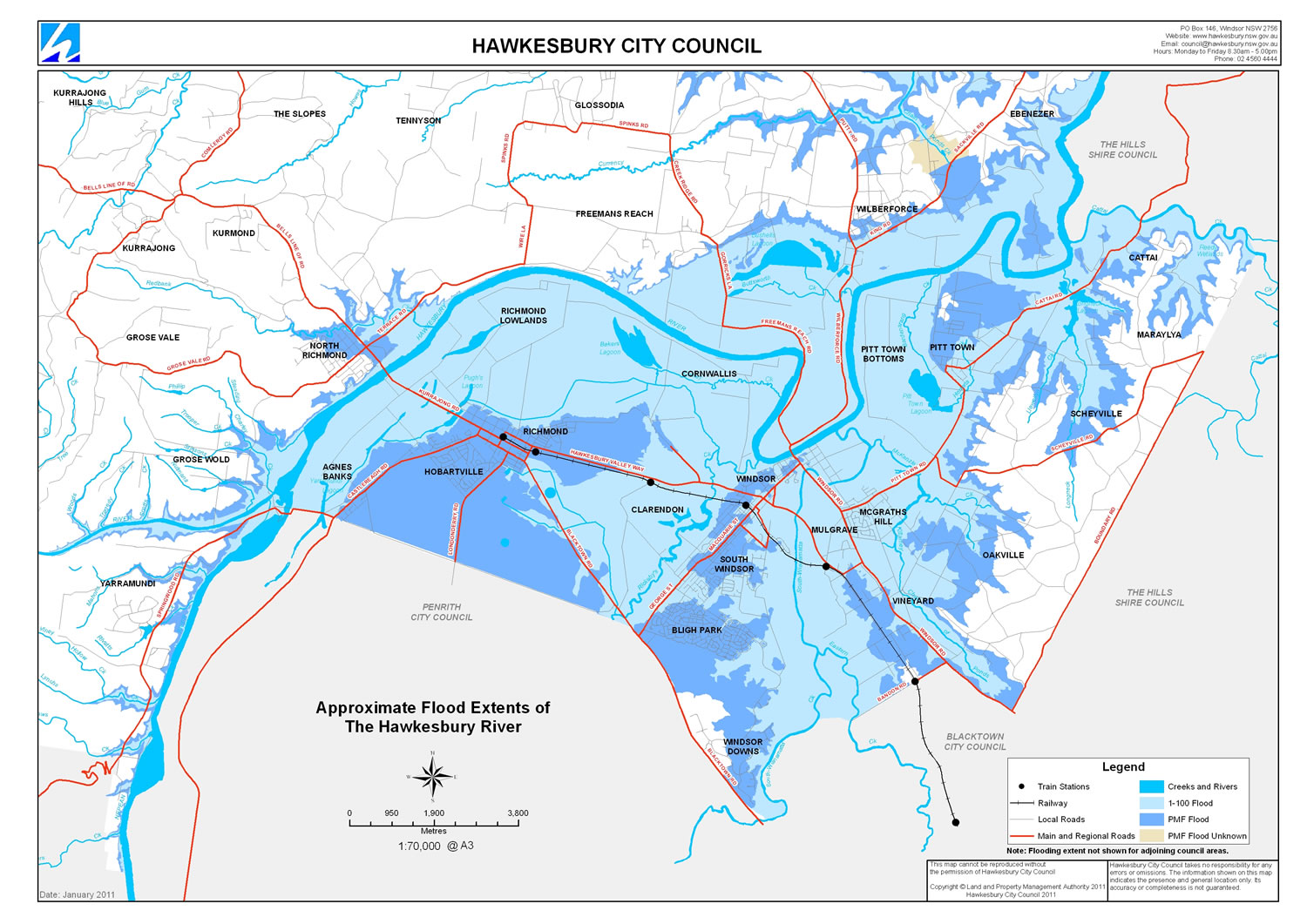
I hate to say it, but it is inevitable that one day we will have a flood in the Hawkesbury-Nepean as least as serious as the historic one we are currently seeing Queensland, and it won't be until then that we'll get real action on flood mitigation in this area.
Then all the pollies will wail about the loss of property and life, all the residents who've moved into the area and have no idea what it's like to live on a floodplain will ask why they were allowed to build or buy in flood-prone areas, and all the Cassandras will say "we warned you for years, and you ignored us."
The map above shows the extent of the largest historical flood experienced in the Hawkesbury, in 1867. If you live around the Hawkesbury, there are two markers you need to visit. One is a nail in the outside wall of the Macquarie Arms pub at Windsor. A second is in the grounds of Windsor Public School. If you cast your eyes across from either of those points and use your imagination, you may get a sense of the scale of a major flood. The water reached that level in 1867. Now look at that map again. If you live in the Hawkesbury, there's a better than even chance that your home lays in that blue area, since our population is densest around Windsor, South Windsor, Bligh Park, Richmond and so on. And any flood will not have to be of the scale of the 1867 event to be catastrophic. This year marks 50 years since the last big flood in living memory, in 1961. It's a common misconception of statistics to think that a statistically overdue event becomes more likely as time passes, but it underlines that a generation of Hawkesbury and Penrith area residents have little personal experience of a big flood. The terrible things we are seeing on TV today will one day play out in our own back yards. Why should we believe that something that has happened many times before will not happen again?
Warragamba dam is not a flood mitigation dam. It has a capacity of 4 sydney harbours. It will only reduce flooding by the amount of storage it has available when it starts raining, which at the moment is 1 sydharb (It is 73% full) (2nd March 2012 note: It is now over 98% full and has increased by 0.5% in less than a day).
Warragamba's catchment extends from Lithgow to Lake George near Canberra. It could easily fill in 1-2 days. Wivenhoe dam (Brisbane) is a flood mitigation dam, holding 5 Sydharbs, 3 for drinking and 2 for flood mitigation. As you just witnessed this is to reduce frequent little floods. It does little to reduce a major flood event.
The rivers flowing through Rockhampton recently received something like 300+ sydharbs in a month. Talk of flood mitigation in that catchment is just that, talk.
Unfortunately, if the catchment above warragamba received anything like the rainfall recently seen in Qld, or Vic for that matter, the free capacity in warragamba would be of little significance.
So what will we do? What should be being done now?
8 comments:
It's good to be aware of this. Can they mitigate rapid downpours by using the dam as a buffer, thus lowering the risk?
I believe that Warragamba dam, as built, lessens the maximum probable flood by some degree, and may decrease the frequency of minor flooding. This is because the dam allows a degree of control over the release of water into the downstream river. The problem comes when the dam is full, and 100% of the inflow is obliged to be released straight away. People look at the dam and say "but it's only half full. Surely we can't flood if it's that empty?" What they don't realise is that it would only take a week's rain falling in the right area of its catchment (which extends most of the way towards Goulburn) to get to 100% and then over 100%. Then, a major flood is on.
It's interesting that even after the construction of the Wivenhoe Dam in QLD after the record 1974 floods Brisbane still managed a catatrosphic flood level within 1m of the 1974 floods. This just goes to show that even with the Warragamba Dam in place major flooding of the Hawkesbury is still a very real possibility.
As I am relatively new to the Hawkesbury and after seeing the QLD floods I am particularly interested in researching the impact a major flood would have on the suburb where I am now living. Are there any good websites for researching information like this or is a call to the Hawkesbury City Council the best option?
Apart from the above map, your options are limited.
I was speaking to the chair of the Hawkesbury-Nepean Flodplain Management Committee, Kevin Conolly recently and asked "So, if a local resident wanted to know what elevation their property was at, how would they do it". His reply was "not online. They would have to call to attend the inquiry counter at the Council chambers and ask."
The 1:100 flood building limit is 17.3m, at Windsor. Elsewhere it may vary. Your flood susceptibility will vary on factors like the relative inflow and outflow rates in your suburb, and so the ultimate flood peak will vary from place to place.
In times of high rainfall and approaching flood, it is reasonable to assume that the 1 sydharb of 'flood mitigation capacity" of the dam will be filled either in advance of the flood proper, or very soon thereafter.
From that time onwards, it is a matter of engineers running a flood routing model with inputs of rainfall either measured or predicted from within the upstream catchment. Thus, it is imperative to get away from the notion which is still around in some SES units that goes "I can only deal with the flood which confronts me". I have heard this phrase time and again in the Hunter. It is dead wrong and dangerous, to boot.
The best and only advice should ideally come from the engineers and meteriologists who model river behaviour and the weather/rainfall.
The Hawkesbury is a special case, because there may not even be 24 hours between the time at which the potential for a catastrophic flood and the closure of critical exit roads. This time is precious. It should not be wasted, but the flood will not have "confronted" Joe Public or the local SES Controller.
Flight to high ground, eg McGrath's Hill, will be the only available option, yet McGrath's Hill will be very much under water in the event of a PMF or even a 1:300 years 1867-style flood. Those who take refuge on this hill will be lost.
For what it is worth, I can only recommend that those who live on this flood plain carefully identify and monitor reliable flood monitoring information and be prepared to exit by road IMMEDIATELY a major flood is predicted, with no regrets or cares about the condition of the property and contents that they leave behind.
The roads will be clogged very quickly and will remain clogged. The flight to ground which is above PMF, ie about 10 or 15 metres above the 1:100 flood level is the only important issue once the flood rains are on the horizon.
I write this as a retired engineer, with a past involving management of large dams and training in flood routing. The Hawkesbury Valley has potential for disaster. Once the circumstances arise, individual action will be all that count, because there is no organisation which can reach out to McGrath's or any other hilltop and rescue you and your loved ones. There will be thousands of others in the same situation and only resources adequate for rescue of a few percent of the needy.
It is up to individual residents to be aware and to respond. Know your exit route. Plan in advance. Leave as soon as you know that it MAY be necessary.
Hi I'm close to buying a cottage at Milsons Passage near Brooklyn. And I'm concerned about the potential for flooding. I can't see the Passage referred to on any maps anywhere. Can anyone please tell me what the flood history is for the Passage?
Thanks, Barry
barry@barrynovis.com
0448 925 118
Barry, when you're that far downstream (near Mooney Mooney, yes?), the ebb and flow of the river is completely tidal and rainfall upstream isn't going to raise the level of the river much at all. I'd suggest you start with your local Council for confirmation.
Post a Comment